






NEWS
Accepting
Graduate Students
for Fall 2011
Information
Most recent
publications:
Reinforcement in chorus frogs: lifetime fitness estimates including intrinsic natural selection and sexual selection against hybrids.
Evolution 2010: 64:1748-1761
Pdf
When trees grow too long: investigating the causes of highly inaccurate Bayesian branch lengths. Syst. Biol. 2010: 59:145-161.
Pdf
PhyloMapper 1b1
Released
Download
Welcome to the
Lemmon Lab
Research in the Lemmon lab focuses on the application of novel statistical and computational approaches to interesing areas of evolution: phylogenetics, phylogeography, speciation, population genetics, and genomics.
We take a unique approach to developing these fields that includes the integration of computational, statistical, and empirical research. A complete understanding of any evolutionary process can only be obtained through the integration of empirical and theoretical research. Thus, we strive to incorporate lab and field work into our research, in addition to collaborating extensively with empirical biologists.
Our phylogenetic research has explored the use of a novel genetic algorithm to solve a difficult and important problem: the estimation of large phylogenies. Future work will aim to apply this efficient algorithm to other difficult problems.
We have also used large scale simulations to study the effects of model mis-specification and missing data on the accuracy of Bayesian phylogenies. Future research will develop methods for estimating phylogenies using genomic data.
Our research in phylogeography has involved the development of a new maximum likelihood method for estimating patterns of migration across a continuous landscape using genetic data. Future development of this method will employ Bayesian techniques to integrate genetic, environmental niche, and other types of data. The purpose of this research will be to provide a statistical framework for estimating the relative importance of different barriers in the diversification of a species
We are also using next-generation sequence data to develop molecular tools for phylogenetics, phylogeography, and population genetics.
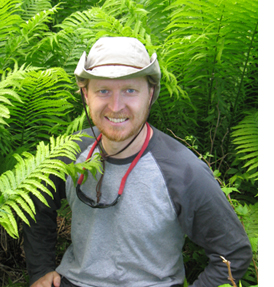
Alan R. Lemmon
Dept. of Scientific Computing
Dept. of Biological Science
150-A Dirac Science Library
alemmon+aT+evotutor.org